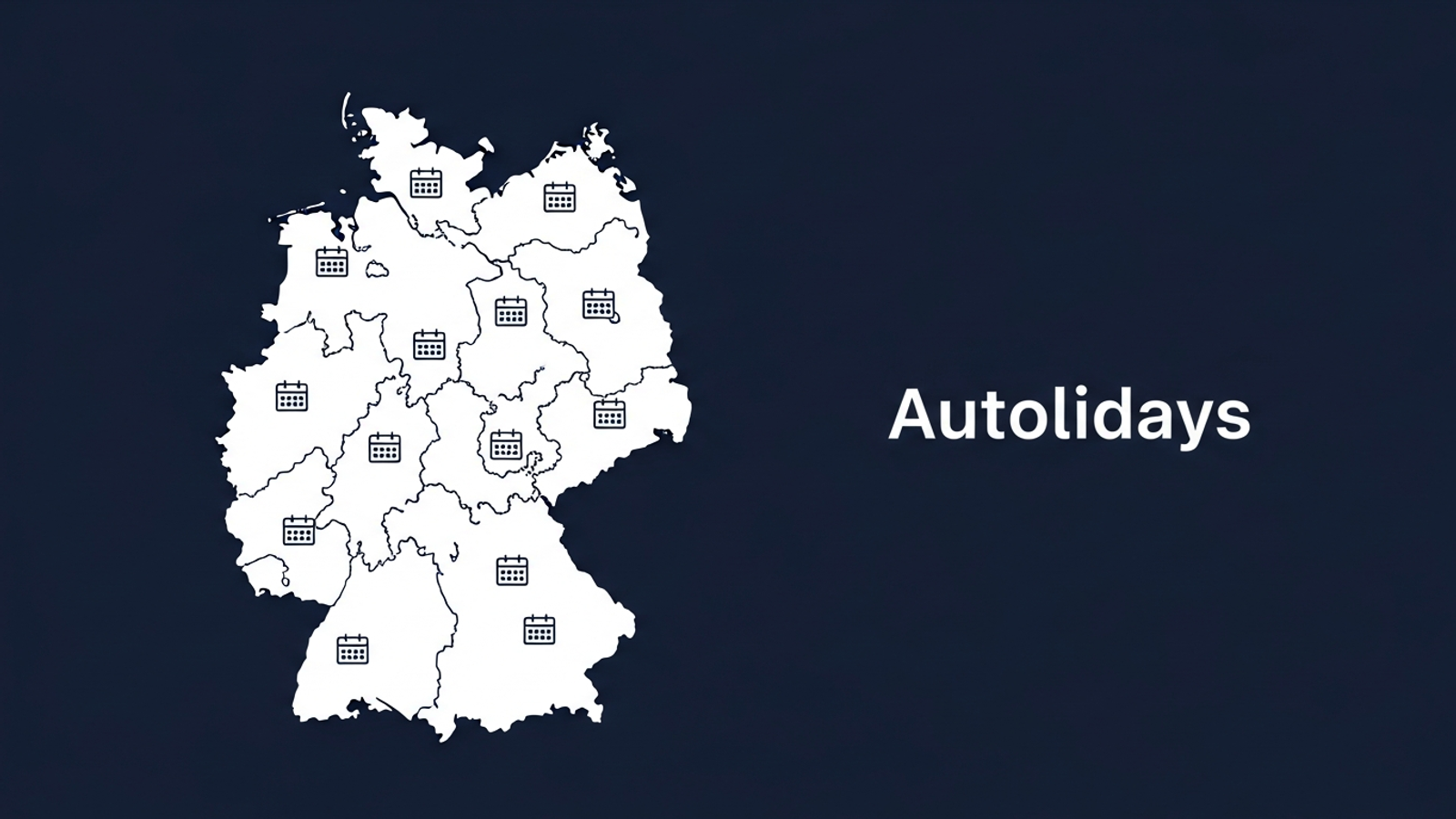
Germany's public holiday system is one of the most decentralized in Europe. Unlike countries with a single national holiday calendar, Germany gives each of its 16 federal states (Bundesländer) the authority to set their own public holidays beyond a small set of nationwide observances.
The result: Bavaria has more public holidays than Berlin. Cologne observes Corpus Christi; Hamburg does not. If you schedule a team call on 15 August without checking where your German colleagues are based, you may find your Bavarian team absent.
This guide explains Germany's 2026 public holiday structure, highlights the key regional differences, and shows how to manage this complexity for distributed teams.
Germany's National Public Holidays 2026 (All States)
These nine holidays are observed in every German state:
- 1 January — New Year's Day (Neujahr)
- 3 April — Good Friday (Karfreitag)
- 5 April — Easter Sunday (Ostersonntag)
- 6 April — Easter Monday (Ostermontag)
- 1 May — Labour Day (Tag der Arbeit)
- 14 May — Ascension Day (Christi Himmelfahrt)
- 24 May — Whit Sunday (Pfingstsonntag)
- 25 May — Whit Monday (Pfingstmontag)
- 3 October — German Unity Day (Tag der Deutschen Einheit)
- 25 December — Christmas Day (1. Weihnachtstag)
- 26 December — St. Stephen's Day (2. Weihnachtstag)
State-Specific Public Holidays 2026
Bavaria (Bayern) — 13 public holidays
Bavaria has the most public holidays of any German state, owing to its predominantly Catholic population:
- 6 January — Epiphany (Heilige Drei Könige)
- 15 August — Assumption of Mary (Mariä Himmelfahrt)
- 1 November — All Saints' Day (Allerheiligen)
- 4 June — Corpus Christi (Fronleichnam)
Baden-Württemberg
- 6 January — Epiphany
- 4 June — Corpus Christi
- 1 November — All Saints' Day
North Rhine-Westphalia (NRW — Düsseldorf, Cologne, Dortmund)
- 4 June — Corpus Christi
- 1 November — All Saints' Day
Rhineland-Palatinate
- 4 June — Corpus Christi
- 15 August — Assumption of Mary
- 1 November — All Saints' Day
Saarland
- 4 June — Corpus Christi
- 15 August — Assumption of Mary
- 1 November — All Saints' Day
Saxony
- 31 October — Reformation Day (Reformationstag)
Thuringia
- 31 October — Reformation Day
Brandenburg
- 31 October — Reformation Day
Hamburg, Bremen, Lower Saxony, Schleswig-Holstein, Mecklenburg-Vorpommern
- 31 October — Reformation Day
Berlin, Saxony-Anhalt
- 31 October — Reformation Day
- 8 March — International Women's Day (Berlin only)
The Practical Problem: Bavaria vs. Berlin
Let us make this concrete. A company with offices in Munich and Berlin:
- Bavaria has Epiphany (6 January), Corpus Christi (4 June), Assumption of Mary (15 August), and All Saints' Day (1 November) as state-specific holidays
- Berlin has International Women's Day (8 March) and Reformation Day (31 October)
That means four days exist where your Munich team is off but your Berlin team is at work, and two days where the opposite is true.
For an internationally distributed team, this compounds further: Germany has 9 national holidays, but a team member in Bavaria could have up to 13 public holidays total.
How to Handle German Regional Holidays for Your Team
Option 1: Use the most conservative calendar
Treat all employees as having the same holidays as the state with the most holidays (Bavaria). This guarantees no one is scheduled to work on a holiday, but it costs more total days off.
Option 2: Track each state separately
Maintain a per-state holiday calendar and block those specific days for employees in that state. More accurate but requires more setup.
Option 3: Automate it
Autolidays imports German state-level public holiday data automatically. Specify which state each team member is in, and their calendar gets blocked with the correct holidays for their location.
View Germany's public holiday data at /holidays/germany.
Frequently Asked Questions
Why does Bavaria have so many public holidays?
Bavaria has a predominantly Catholic population, and several Catholic feast days are recognized as state public holidays: Epiphany, Corpus Christi, Assumption of Mary, and All Saints' Day. Secular northern states like Hamburg and Berlin do not observe these.
Is Corpus Christi a public holiday in all of Germany?
No. Corpus Christi (Fronleichnam) is only a public holiday in predominantly Catholic states: Bavaria, Baden-Württemberg, North Rhine-Westphalia, Rhineland-Palatinate, Saarland, and parts of Hesse and Saxony-Anhalt.
What if my German employee moves from one state to another?
They are entitled to the public holidays of the state where they live and work. Update their location in your HR system and adjust their holiday calendar accordingly.
Is German Unity Day observed everywhere?
Yes. 3 October (Tag der Deutschen Einheit) is a national holiday observed in all 16 federal states. It is one of the few holidays on the standard list.
Automate German Holiday Tracking
Managing holiday calendars across multiple German states manually creates real scheduling errors. Autolidays handles this automatically, syncing the correct state-level Feiertage to your Google Calendar so your availability reflects where you actually are.